
An international research collaboration supported by the Rainwater Charitable Foundation unveiled its first findings at the 2026 Tinnitus Research Initiative Conference in Berlin, bringing us closer to objectively detecting tinnitus and understanding why it differs from person to person.
Imagine hearing a ringing, buzzing, or hissing sound that no one else can hear. Now imagine trying to explain how loud it is or whether a treatment is working, without any objective way to measure it.
For millions living with tinnitus, this is reality. Without an established objective clinical test, researchers and clinicians rely largely on patient-reported experiences, making it difficult to evaluate new treatments.
What if we could detect tinnitus by measuring how the brain functions?
That is the ambitious question behind the Tinnitus Detection (TIDE) Consortium, which shared its first findings at the Tinnitus Research Initiative (TRI) Conference in Berlin in September 2026.
Seven Research Sites, Five Countries, One Big Question
Supported by the Rainwater Charitable Foundation, the TIDE brought together researchers from seven clinical research sites across five countries to tackle a challenge that has frustrated the tinnitus field for decades.
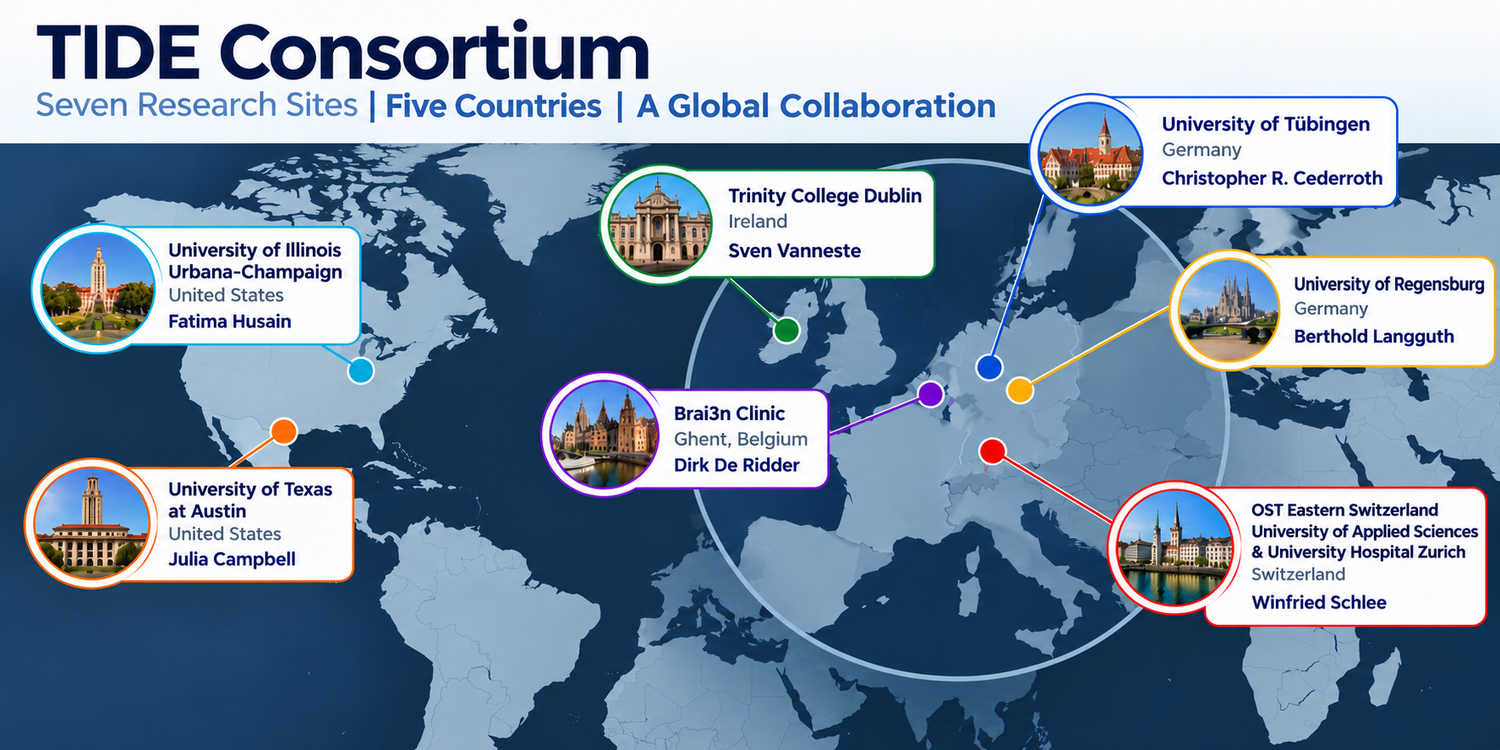
The international team includes:
- Sven Vanneste — Trinity College at The University of Dublin, Ireland
Research team: Anusha Yasoda-Mohan, Elva Arulchelvan, Nathan Shields - Christopher R. Cederroth — University of Tübingen, Germany, and Karolinska Institutet, Sweden
Research team: Hongyu Lu, Stephan Wolpert, Christoph Braun - Dirk De Ridder — Brai3n Clinic, Ghent, Belgium
Research team: Frederique Moreels, Jessy Neyt, Sarah Rambour - Berthold Langguth — University of Regensburg, Germany
Research team: Susanne Staudinger, Milena Engelke, Stefan Schoisswohl - Fatima Husain — University of Illinois Urbana-Champaign, United States
Research team: Shagun Ajmera, Emilia Kaniewska, Gibbeum Kim, Namitha Jain - Julia Campbell — University of Texas at Austin, United States
Research team: Lauren Ralston Ruesch - Winfried Schlee — OST Eastern Switzerland University of Applied Sciences and University Hospital Zurich, Switzerland
Research team: Patrick Neff, Payam Sadeghi Shabestari, Beat Tödtli, Tobias Kleinjung
Together, the researchers evaluated more than 560 participants, including people with chronic tinnitus and individuals without tinnitus. Beyond recording brain activity, they assessed hearing, tinnitus symptoms, anxiety, and sound sensitivity.
This comprehensive approach matters because hearing loss and other factors can independently influence brain activity, making it essential to distinguish tinnitus-specific signals from unrelated changes.
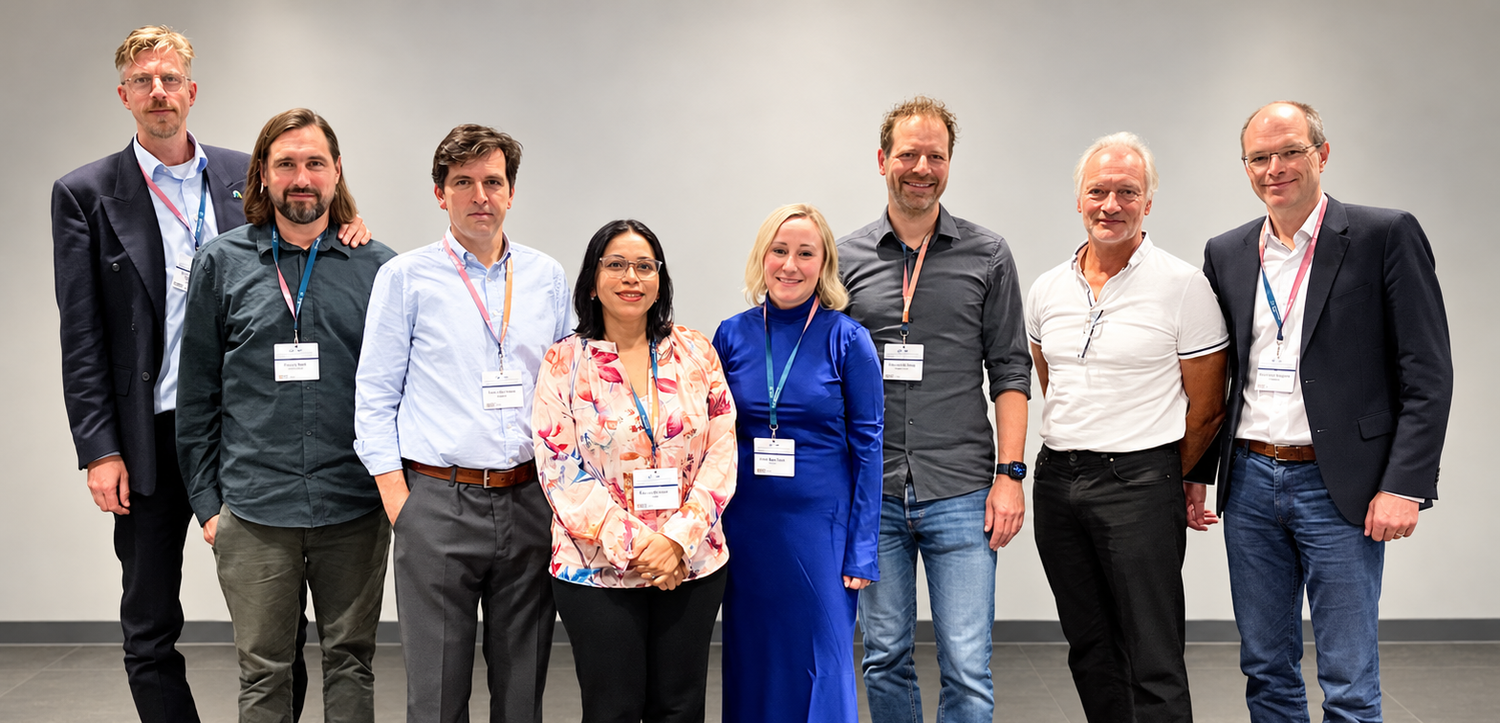
Three Different Ways to Listen to the Brain
Rather than assuming tinnitus has a single biological signature, TIDE investigated three ways the brain processes sound and information using electroencephalography (EEG), a noninvasive method of measuring electrical activity through sensors placed on the scalp.
- How does a brief moment of silence change the brain’s response to sound? Using gap-prepulse inhibition, researchers introduced tiny silent gaps into background noise and measured the brain’s response to a subsequent sound. Normally, detecting the gap suppresses this response, but TIDE found that this inhibition was reduced in people with tinnitus.
- How does the brain respond when an expected sound is missing? Our brains constantly predict what will happen next. Using an auditory oddball experiment, researchers found altered brain responses to unexpected sound omissions in people with tinnitus, suggesting differences in how the brain anticipates and processes sound.
- What does the brain do when no sounds are being presented? Using resting-state EEG, researchers examined communication between brain networks while participants rested quietly. This approach produced some of TIDE’s most promising findings.
The Most Promising Signal May Be in the Brain’s Networks
When researchers compared the three approaches, resting-state EEG emerged as the strongest method for distinguishing participants with tinnitus from those without it. Using machine learning, the researchers achieved an AUC of approximately 0.80, where 0.50 represents chance and 1.0 represents perfect discrimination.
This raises an exciting possibility: Could a relatively simple resting-state brain recording eventually provide much of the information needed to objectively detect tinnitus?
If so, future testing could become shorter, less burdensome, and more accessible.
Interestingly, the strongest predictive information was not confined to the auditory system. The team identified increased connectivity within the brain’s frontoparietal network.
These findings suggest tinnitus may involve not only auditory perception but also how broader brain networks process and respond to internally generated sound.
An Important Test: Does It Work Beyond One Laboratory?
A major challenge in biomarker research is reproducibility. Findings that appear promising in one laboratory often fail when tested elsewhere because of differences in equipment, participants, and testing environments.
TIDE addressed this through leave-one-site-out validation, training machine-learning models using data from six sites and testing them on participants from the seventh, previously unseen site. This process was repeated across the participating centers.
The resting-state model demonstrated promising performance across sites, suggesting the identified brain patterns are not limited to a single laboratory—an important step toward developing a biomarker that could eventually be used in different clinical settings.
Perhaps There Isn’t Just One Type of Tinnitus
Tinnitus varies enormously between individuals, from mild symptoms to sounds that severely interfere with daily life. But could these differences reflect distinct biological forms of tinnitus?
By combining all three EEG experiments, TIDE researchers identified three preliminary neurophysiological patterns, or archetypes, among participants with tinnitus.
Although further validation is needed, these findings raise the exciting possibility of identifying biological subtypes that could ultimately help match patients with more targeted treatments.
What Comes Next?
While the findings are encouraging, TIDE has not yet produced a clinically validated diagnostic test.
Next steps include independently validating the results, accounting for differences in hearing loss and tinnitus severity, and simplifying the testing process without compromising accuracy. Researchers also hope to determine whether these brain signatures can track changes in tinnitus severity and measure treatment effectiveness.
Building the Foundation for Better Treatments
At the Rainwater Charitable Foundation, we believe tackling difficult medical challenges requires more than supporting individual discoveries. It means bringing together talented researchers, encouraging collaboration, and building the tools that make future breakthroughs possible. TIDE represents that approach.
By connecting seven research sites, harmonizing complex measurements, and applying advanced analytical methods, the consortium has created a scientific foundation that extends well beyond any single finding.
The results presented at TRI 2026 mark an exciting milestone, but they are also a beginning. While much remains to be validated, TIDE has demonstrated promising cross-site classification of tinnitus using measurable brain activity and begun uncovering biological differences that may help explain why tinnitus varies so widely.
For a condition historically defined almost entirely by what patients can tell us, the possibility of objectively measuring what their brains are experiencing represents an important step forward.
The TIDE Consortium is supported by the Rainwater Charitable Foundation. Findings were presented at the Tinnitus Research Initiative Conference in Berlin, Germany, on September 17, 2026. Results are preliminary and require further independent validation before clinical use.