Over the past six years, the Rainwater Charitable Foundation (RCF) has been expanding our work in asset-building and access to capital for individuals and communities. Too many families face barriers on their path to build income, increase access to capital, and acquire assets. The scope and scale of associated challenges can be daunting, for instance:
- Affordable Housing – the DFW region has a shortfall of more than 85,000 homes that are priced to align with the budget of working families;
- Predatory Lending – in 2023, payday and auto title lenders issued nearly 60,000 new loans in the Fort Worth area with a total loan volume of $205 million, 38% of which represented fees alone ($78 million).
As we considered challenges like these, it was apparent we needed to reconsider strategies to deploy our own philanthropic capital, namely through program-related investments (PRIs). Whereas traditional grants are expended once with no expectation of a financial return, PRIs are structured as loans, loan guarantees or equity investments that are generally recovered in part or in whole, and may even earn a below-market return. Because PRIs serve primarily to advance a charitable purpose and the financial return is not considered “significant” by market standards, these investments count toward a foundation’s required charitable distribution.
Foundation Source outlines several key advantages that PRIs convey to foundations, including:
- The ability to more comfortably consider a larger outlay of funds than might be possible as a grant, knowing that the principal will eventually be repaid.
- The ability to reuse or “recycle” the same dollars for the benefit of multiple organizations.
- The ability to invest capital from the grantmaking budget in commercial opportunities that align with the foundation’s mission but otherwise would not merit a permissible business investment of endowment funds.
- Serving as a point of leverage to attract other lenders or investors to a worthy project by taking on early risk or accepting lower returns to make room for more traditional sources of capital.
- Capacity-building for partner organizations by improving cash flow, strengthening their credit history, building financial capacity, and fostering long-term sustainability.
Foundations might consider partnering with intermediaries like community development financial institutions (CDFIs) to contribute PRI dollars to a managed fund that can even focus on specific geographies or project types. For instance, LISC manages multiple funds across the nation that seek to increase affordable housing and provide capital for small businesses. However, foundations can also make direct loans to a nonprofit or for-profit entity to capitalize a project with a charitable purpose. By making loans directly, foundations would have more control over the scale and terms of their PRI portfolio and the freedom to pursue a level of diversity that best suits their mission and risk tolerance.
In 2025, RCF made two program-related investments aligned with our focus on improving family economic security. We provided an equity equivalent (EQ2) investment to Capital Good Fund, a CDFI focused on equitable financing. An EQ2 investment is a fully subordinated, long-term loan that functions like equity to strengthen the balance sheet of the borrower. EQ2 loans enhance a borrower’s lending flexibility and increase its debt capacity by protecting senior lenders from losses. Unlike permanent capital, an EQ2 must eventually be repaid and requires interest payments during its term, although at a rate that is often well below market. Our EQ2 investment with Capital Good Fund helped capitalize and expand the Impact Loan in North Texas. This program offers an alternative to predatory loans that pose a severe financial risk which disproportionately affects low-income borrowers. With support from partners like RCF, the Impact Loan program can provide broad access to small-dollar ($300-$1,500) loans with a fixed interest rate of 12%. In the first 5 months of our partnership, Capital Good Fund issued 123 loans in our region with an average loan size just over $1,000. By offering these loans at a 12% rate, the Impact Loan program helped borrowers build credit safely, demonstrate repayment success, and avoid the burden of predatory-interest debt. Over the course of repayment, these loans will have saved an estimated $9,323 per household compared to a 600% APR loan over an 18-month repayment period.
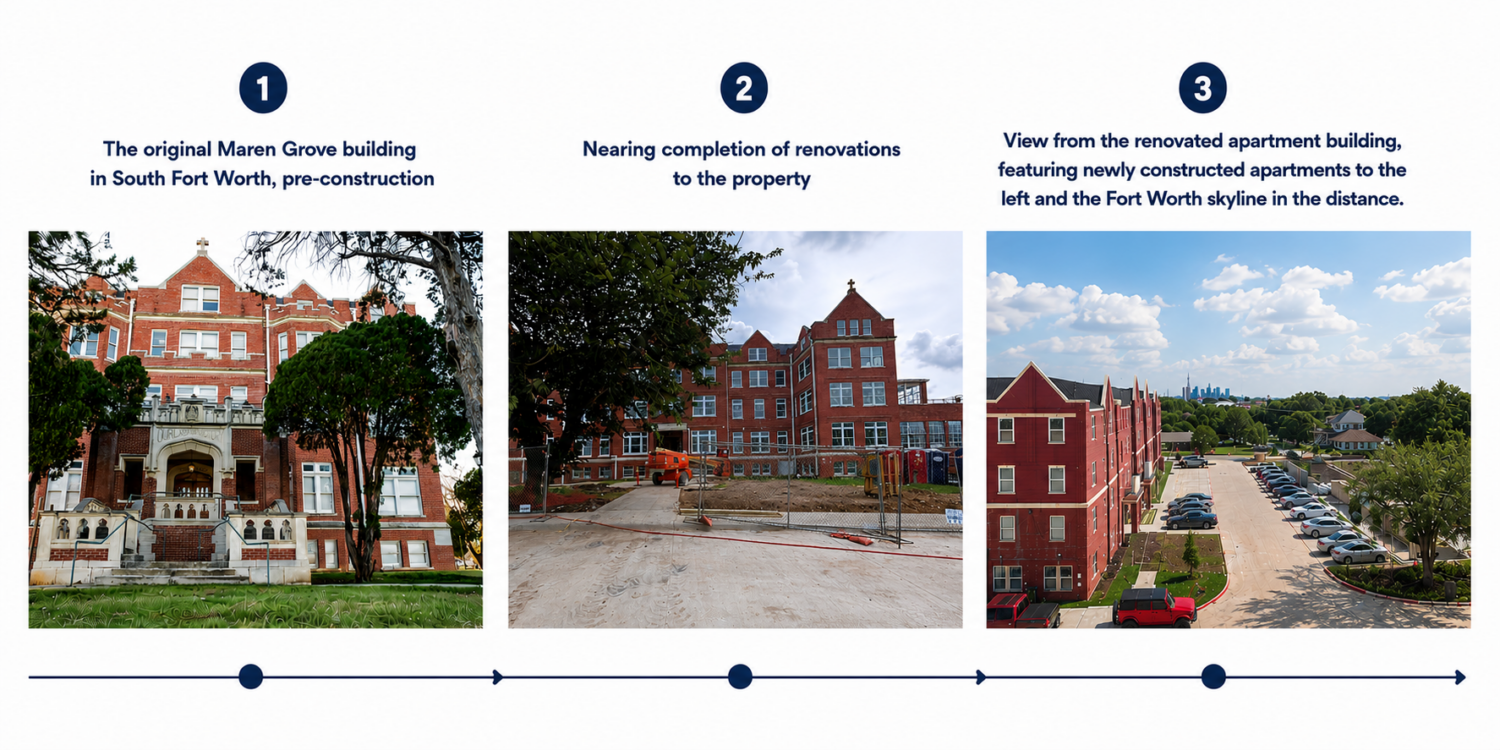
In the housing sector, RCF provided a loan for the development of the 90-unit Maren Grove property in South Fort Worth. This project was awarded low-income housing tax credits (LIHTC) which can be sold to equity investors as a key source of project financing. Even with the LIHTC award and a senior lender on board, gap financing is an increasing concern for affordable housing projects like Maren Grove due to higher interest rates and increases in hard costs (i.e., materials, labor) and operating costs (i.e., insurance). RCF contributed subordinate, concessionary debt in syndication with the senior lender, which placed us higher in the capital stack and created opportunities to collaborate on due diligence, financial modeling, and reporting. With the support of gap funding from RCF, CDFI partners, and the City of Fort Worth, we have collectively preserved and repurposed an historic landmark in the Shaw-Clarke neighborhood. Families earning between 30% and 80% of the area median income will have a high-quality, one-of-a-kind place to call home with access to a preschool program on the property.
Creative, diverse capital stacks are critical to the execution of projects like the Impact Loan program and the Maren Grove property. For families in North Texas — whether navigating a financial emergency or searching for a stable, affordable home — these investments represent more than capital. They represent access to opportunity that might otherwise be out of reach. RCF is continuing to explore how program-related investments can complement our grantmaking to support partners doing this work. We believe similar projects exist in every community with the potential to generate positive, long-term social impact and power an engine of revolving philanthropic capital. We welcome the opportunity to come alongside peer funders and nonprofit partners in North Texas to explore this potential. To learn more or connect with our team, contact information@rainwatercf.org.